How to Choose a Powder Coating Dip Tank for Metal?

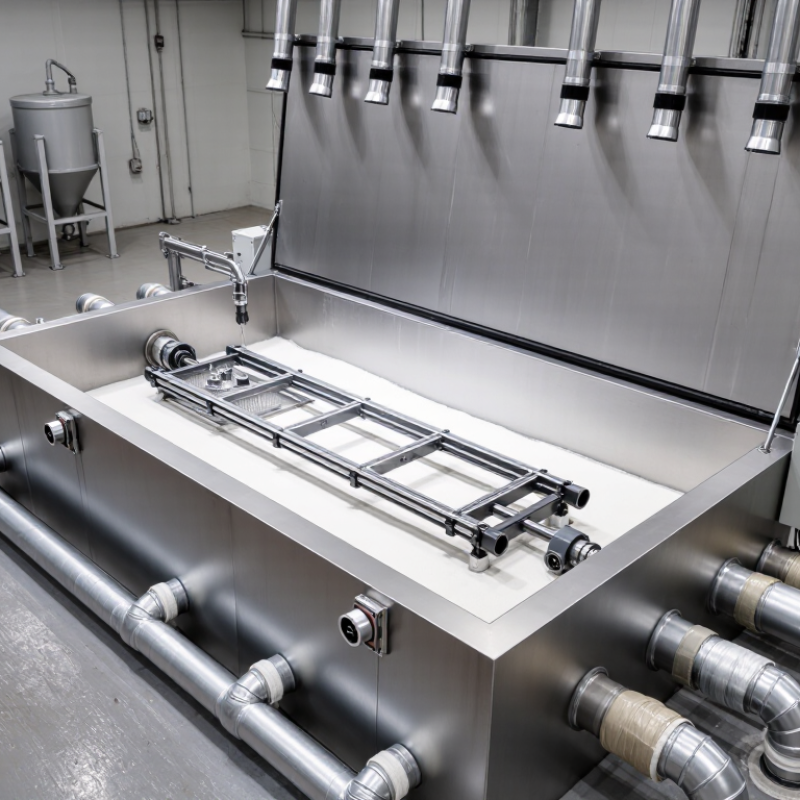
Choosing a powder coating dip tank for metal is more than selecting a container with a blower. The tank becomes the center of coating consistency, production speed, and operator safety. A poor choice may leave thin corners, uneven coverage, or wasted powder beneath the workpiece.

Kevin Biller, founder of The Powder Coating Research Group, has stated, “The coating will only be as good as the substrate preparation.” That principle matters in every powder coating dip system. Clean steel, controlled preheating, stable air distribution, and correct powder depth must work together. If one element fails, the finish usually shows it.

Begin with the metal parts. Their length, weight, shape, and heat capacity determine the required tank dimensions. A small bracket may need a compact fluidized bed. A long frame needs greater immersion space and carefully balanced airflow. Check the tank’s heating method, insulation, temperature controls, powder recovery, and ventilation. Ask how quickly operators can remove the parts. Seconds matter.

Do not overlook maintenance. Filters clog. Powder settles. Sensors drift. These details are not glamorous. They affect real production.

A reliable tank should offer steady fluidization across its entire surface. It should also support grounding and repeatable temperature monitoring. Stainless steel construction may improve durability, but it can increase the purchase price. That trade-off deserves honest review.

The best decision is not always the largest tank. It is the tank that matches your parts, workflow, powder chemistry, and future capacity. Measure twice. Question assumptions. Even experienced teams sometimes choose equipment before testing the actual metal parts. That mistake can become expensive.
How to Choose a Powder Coating Dip Tank for Metal?

Understanding the Purpose and Process of a Powder Coating Dip Tank

A powder coating dip tank prepares metal before powder application. It removes oil, rust, and shop dirt through cleaning, rinsing, and chemical treatment. The prepared surface improves adhesion and corrosion resistance. The Powder Coating Institute identifies pretreatment as a critical factor in coating performance. Small contamination can cause blistering, pinholes, or early failure.

Tank selection should match the part size, production speed, and treatment chemistry. Check working volume, heating control, filtration, drainage, and ventilation. Stainless steel or properly lined construction often resists aggressive chemicals better.

Fortune Business Insights valued the global powder coatings market at about USD 15.8 billion in 2024. That growth increases pressure for stable, repeatable pretreatment. Yet, a larger tank is not automatically better. It may waste energy and chemical solution. My practical view is simple: measure the largest real part, not the imagined future part.

Tips:

Keep separate rinse stages where possible.
Monitor pH, temperature, concentration, and tank contamination.
Record readings daily.
Replace solution when tests show declining performance, not only when the tank looks dirty.
Operators should inspect drain holes and hidden cavities carefully.
These areas often retain chemicals and create coating defects.

A perfect process rarely exists; regular testing and small adjustments usually deliver better results.

Identifying Tank Materials, Dimensions, and Load Requirements

Selecting a powder coating dip tank starts with the treatment chemistry, not the lowest quoted price. The bath may contain alkaline cleaners, acidic solutions, or additives that attack unsuitable materials. Polypropylene often handles many chemical baths and moderate heat, while PVC may suit cooler processes. Mild steel can work in selected alkaline applications, but corrosion protection must be verified. Never assume compatibility.

Ask for written chemical-resistance data at the intended operating temperature. Tank walls should have smooth welds, reinforced corners, and accessible drains. A poorly supported base can distort when the bath is full. Tank dimensions must fit the largest metal part, fixture, and lifting path. Measure the actual work envelope.

Leave clearance around every surface for liquid circulation and safe loading. A 1,000-millimeter part may need a longer tank because the fixture adds length. Include enough freeboard to prevent splashing during immersion. This gap is easy to underestimate.

Load calculations should include the part, trapped liquid, fixture, and lifting forces. Do not rate the tank from empty weight alone. A wet fixture can behave differently during withdrawal. Check the floor, support frame, hoist, and attachment points as one system. I have seen layouts fail because the tank was strong, but the access aisle was too narrow. That detail matters. Review the heaviest planned load, not the average production load. If future parts may grow, reserve capacity now, but avoid oversized tanks that waste chemicals, energy, and floor space.

Comparing Heating, Agitation, Filtration, and Safety Features

How to Choose a Powder Coating Dip Tank for Metal?

Heating performance affects coating consistency. Select a tank with closed-loop temperature control and multiple sensors. Uneven heat can soften powder near the walls while leaving the center unstable. A 3–5°C variation may already change fluidization behavior. I would not treat fast heating as automatically efficient. Better insulation often saves more energy than oversized heaters. The U.S. Environmental Protection Agency’s AP-42 guidance classifies powder coating as a low-VOC process, but particulate control remains necessary during powder handling.

Agitation should keep the powder suspended without creating dead zones. Air distribution plates need even airflow across the working area. Excessive agitation can increase dust movement and filter loading. Filtration should include accessible cartridges, pressure monitoring, and simple cleaning procedures. Do not guess. The filter’s rated airflow must match the powder volume and tank geometry. A 2023 corrosion study estimated global corrosion costs at 3.4% of global GDP, or about 2.5 trillion dollars annually. That figure makes coating reliability more than a cosmetic concern.

Safety features deserve equal attention. Use grounding points, guarded moving parts, temperature limits, emergency stops, and lid interlocks. A documented dust hazard assessment should guide electrical equipment selection. NFPA 652 also emphasizes evaluating combustible-dust characteristics, including explosion severity data. Operators need clear visibility around the tank. Small oversights matter. Poorly positioned exhaust can pull powder away from the workpiece and toward nearby equipment.

How to Choose a Powder Coating Dip Tank for Metal? - Comparing Heating, Agitation, Filtration, and Safety Features

Selection Dimension Ambient Chemical Dip Tank Electrically Heated Dip Tank Indirect Steam-Heated Dip Tank Heat-Exchanger Dip Tank Recommended Selection Guidance
Typical Working Temperature 15–30°C (59–86°F) 40–80°C (104–176°F), depending on the chemistry 50–90°C (122–194°F), depending on steam pressure and process design 40–85°C (104–185°F), depending on the heating medium Choose a tank that can maintain the chemical supplier’s specified operating temperature without excessive fluctuation.
Heating Response Not applicable Fast and independently controllable Fast for medium and large tanks Moderate to fast; depends on heat-transfer area Electric heating suits flexible batch work; steam or heat exchangers are often more practical for continuous, high-volume lines.
Temperature Control Usually limited to ambient conditions Digital controller, temperature sensor, and high-limit cutout Control valve, sensor, and independent over-temperature protection Sensor-controlled valve or pump regulation Use closed-loop control and an independent high-temperature limit to protect the solution and tank lining.
Agitation Method Manual circulation or low-speed pump Air sparging or chemical-resistant circulation pump Air sparging or circulation pump Circulation pump with external heat exchanger Agitation should improve chemical contact without creating excessive foam, mist, or turbulence.
Typical Agitation Intensity Low Low to medium; adjustable Medium; adjustable Medium to high; adjustable Adjustable flow is preferable because different parts and chemical stages require different levels of circulation.
Filtration Arrangement Basic strainer or periodic manual cleaning Side-stream bag or cartridge filter, commonly 25–100 microns Side-stream bag, cartridge, or basket filter, commonly 25–100 microns Continuous pump-loop filtration, commonly 10–100 microns Use filtration whenever oils, scale, paint residue, sludge, or particulate contamination can affect pretreatment quality.
Filtration Serviceability Low; frequent manual attention may be required Accessible filter housing with isolation valves Accessible filter housing and drain points Best when designed with bypass, pressure gauge, and quick-change elements Specify a differential-pressure indicator or pressure gauges to identify blocked filter elements before flow is affected.
Tank Construction Polypropylene, polyethylene, or lined steel Polypropylene, stainless steel, or coated steel selected for chemical compatibility Chemically compatible tank with indirect heating coil or jacket Chemically compatible tank with external piping and heat exchanger Tank and seals must be compatible with the cleaning, phosphating, conversion-coating, or other process chemicals in use.
Insulation Requirement Usually optional Recommended to reduce heat loss and surface temperature Strongly recommended for energy efficiency Recommended for stable temperature control Insulate heated sidewalls and exposed piping while keeping inspection points and drains accessible.
Electrical Safety Features Grounding and protected controls Ground-fault protection, emergency stop, grounded enclosure, and high-limit shutdown Grounded controls and protected motor circuits; heating safety is mainly mechanical and process-based Grounded controls, motor overload protection, and emergency stop All electrical components should be selected for the wet and chemically exposed environment and installed according to local codes.
Overfill Protection High-level mark and overflow drain High-level sensor, overflow channel, and automatic fill shutoff High-level sensor, overflow channel, and automatic fill shutoff High-level sensor with pump interlock and overflow protection Include a physical overflow path even when electronic level controls are installed.
Operator Protection Drainage, splash guards, chemical-resistant access area Insulated surfaces, splash guards, lid or cover, emergency stop, and chemical-resistant flooring Insulated surfaces, splash guards, steam isolation valve, lid or cover, and emergency stop Insulated surfaces, splash guards, pressure relief where required, and emergency stop Provide ventilation, suitable personal protective equipment, eyewash and safety-shower access, and clear chemical labeling.
Energy Efficiency Highest when ambient chemistry is acceptable Moderate; improved by insulation and automatic temperature control Good for facilities with efficient steam generation Good when heat is recovered or supplied from an existing hot-water system Compare total energy use, not only heater rating; include insulation, standby losses, pump power, and operating schedule.
Best-Fit Production Profile Small batches, low-temperature cleaning, and low throughput Small to medium batch lines requiring flexible temperature control Medium to large production with available steam infrastructure Large or continuous operations requiring stable circulation and filtration Match tank size and heating capacity to part dimensions, loading frequency, solution volume, and required dwell time.
Key Limitation Cannot support processes requiring elevated temperature Heater element compatibility and electrical load must be checked carefully Requires a suitable steam source and properly designed condensate management Higher initial complexity and additional pumps, valves, and piping Prioritize process compatibility, maintainability, operator safety, and lifecycle cost over initial purchase price.
Values shown are typical engineering ranges for metal pretreatment dip-tank applications. Final specifications should be confirmed against the chemical supplier’s technical data sheet, the metal substrate, production throughput, local electrical and pressure-equipment codes, and the required powder-coating pretreatment process.

Evaluating Chemical Compatibility, Maintenance, and Operating Costs

How to Choose a Powder Coating Dip Tank for Metal

A powder coating dip tank must resist the chemicals used in cleaning, rinsing, and pretreatment. Check the tank material against the solution’s pH, temperature, concentration, and exposure time. Stainless steel may suit some processes, while reinforced polymer tanks can perform better with aggressive chemicals. Do not rely on appearance alone. Ask for chemical-resistance data and test a small coupon under working conditions.

Maintenance affects coating quality and labor costs. Look for smooth internal surfaces, accessible drains, removable baskets, and simple filtration points. Sludge often collects around corners and beneath heating elements. That hidden buildup can change bath chemistry and increase cleaning time. In my experience, a tank that is easy to inspect usually saves more money than a cheaper tank with difficult access. Still, inspection schedules are often underestimated.

Tips: Record bath temperature, pH, concentration, and cleaning time each shift. Compare these records with rejected parts and chemical use. Choose insulated covers and efficient heating controls when the tank operates daily. Calculate the full operating cost, including water, energy, labor, filtration, repairs, and disposal requirements. A lower purchase price can become expensive after repeated shutdowns. The calculation may feel imperfect. It is still better than guessing.

Selecting a Dip Tank Supplier and Verifying Installation Requirements

Choosing a powder coating dip tank begins with the supplier’s engineering evidence, not a polished catalogue. Ask for tank drawings, chemical compatibility data, heating calculations, pump curves, and documented installations handling similar metal parts. A reliable supplier should confirm working volume, freeboard, drainage, access space, ventilation, and lifting loads. These details prevent a tank from becoming an expensive bottleneck.

Request material certificates for the liner, weld inspection records, and a commissioning checklist. The tank must match the pretreatment chemistry, temperature, immersion time, and expected production rate.

The U.S. Environmental Protection Agency reports powder coating transfer efficiency near 95%, compared with approximately 60–80% for many liquid coating applications (EPA, AP-42, Section 4.2). That efficiency still depends on proper cleaning and pretreatment. A poorly sized dip tank can waste that advantage.

Installation requirements deserve a site walk before fabrication. Verify floor loading, bunding, electrical classification, exhaust routing, water treatment, emergency access, and chemical storage distances. NFPA 34 provides recognized guidance for dipping and coating processes involving flammable or combustible liquids, while OSHA 29 CFR 1910.106 addresses related storage and handling risks.

Not every powder coating line uses flammable liquids, but assuming that early is careless. In my experience, suppliers often measure the tank footprint but overlook maintenance clearance. Leave room for filter removal, inspection, and a worker’s awkward reach. That mistake is easy to make.